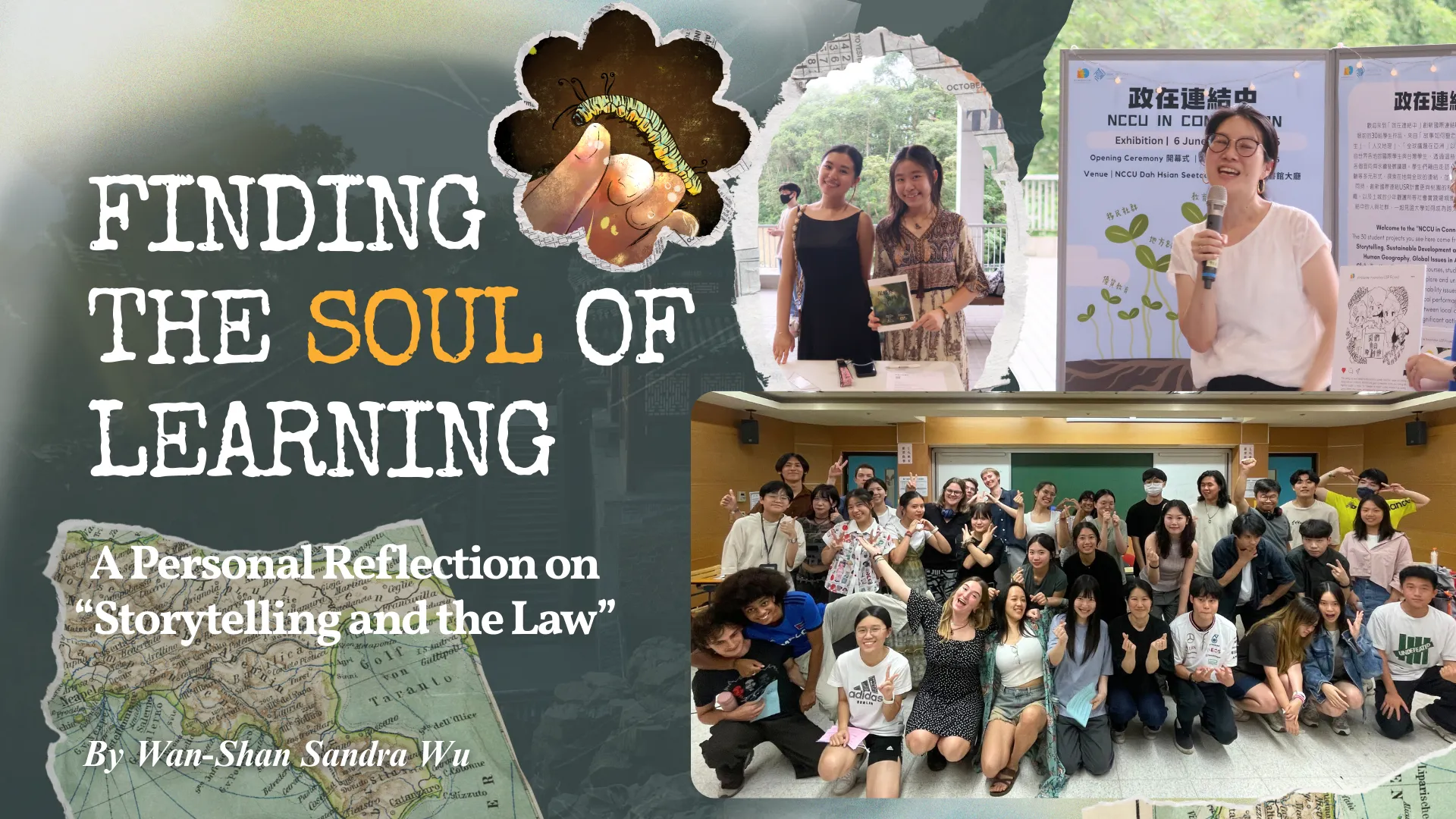
This article is a personal reflection on one of my favorite courses in my relatively short academic career. As a sophomore, I have often found myself navigating the friction between the person I was raised to be and the student I am expected to become. I have long wished to express my gratitude for this course by sharing my thoughts as a heartfelt thank-you for the ways it has transformed me.
To understand why this class felt like a homecoming, I have to take you back to my second semester of freshman year. By then, I had been settled in Taiwan for a year, a place where I was expected to possess a profound understanding due to my roots. Yet, I felt unmoored. Having spent my teenage years in the Kingdom of Eswatini, schooled at a United World College (UWC), my character had been shaped by a very specific kind of friction: the "diversity of exchange." I grew up in a classroom on a mountain, surrounded by peers from every corner of the globe. We bonded in ways that were pure and simple, yet deeply complex in their cultural intersections.
Coming to a traditional university setting in Taiwan felt, at first, like a narrowing of that lens. I became a student increasingly fixated on grades, chasing the external validation of a transcript. But after a semester of classes that felt unrewarding, I realized I was yearning for the fulfillment I once felt on that diverse campus on the mountain.
Then came the invitation. A friend suggested I sit in on a lecture by Professor Michelle Kuo at the International College of Innovation. On one hand, he warned me that her class has a heavy workload (lots of reading, assignments, and participation), which is quite a bit of effort for a 3-credit general course. On the other hand, he promised I wouldn’t regret taking it.
He was right.
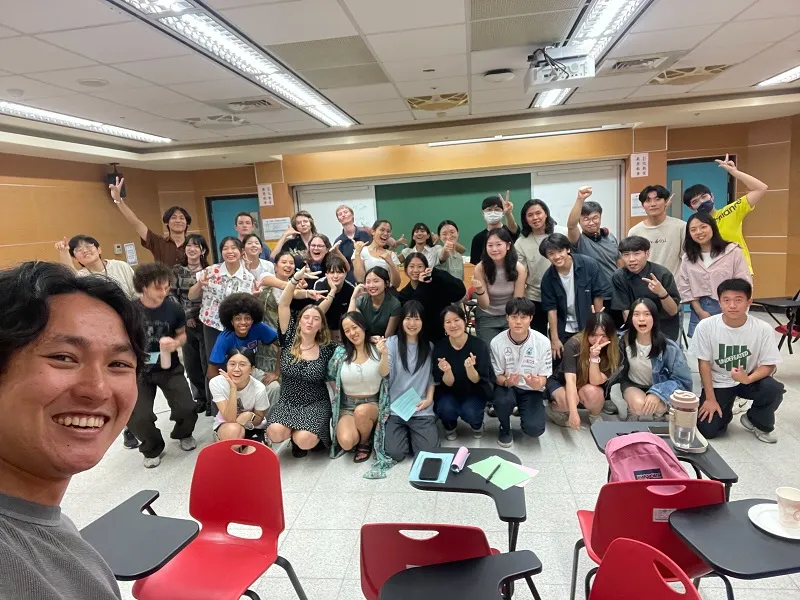
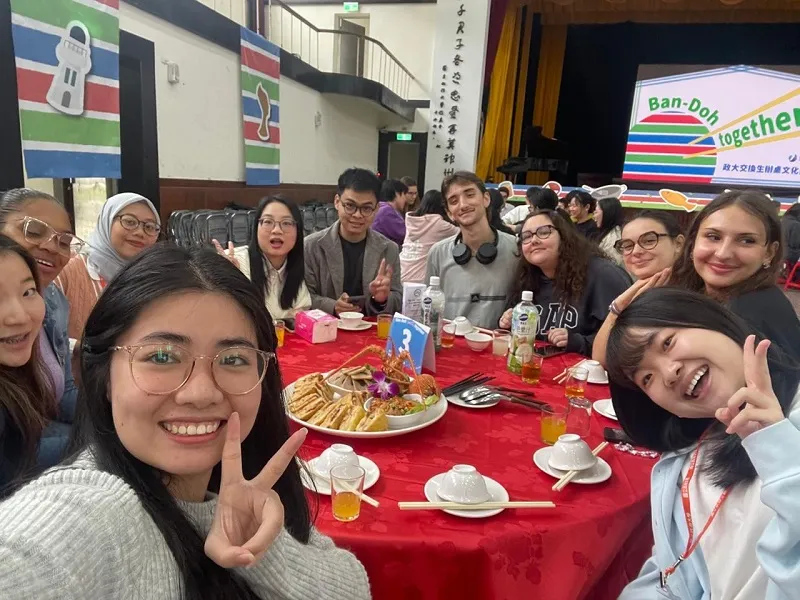
▲Our class group photo during the final farewell party, marking the close of a transformative semester
The Sanctuary of Presence
Walking into Professor Kuo’s classroom was an immediate culture shock, even for someone used to international settings. In an age where the laptop screen is a literal and metaphorical barrier between student and teacher, her classroom was a "dead zone" for technology. No cell phones. No computers.
Initially, I felt a strange sense of exposure. I began to reflect on how often I have escaped into the comfort of hiding behind a screen. Not out of necessity, but as a form of self-protection. It was a way to shield myself from the potentially awkward, raw, and human interactions that define a real classroom. It is sad to realize that many of us have unconsciously isolated ourselves, losing the innate curiosity required to be genuinely interested in another human being through real-time interaction.
One specific ritual dismantled this escapism: the ten-minute activity at the start of every lecture. Professor Kuo required us to stand up, walk to someone we hadn’t spoken to yet, and simply get to know them. To my introverted friends, this sounded like a social nightmare.
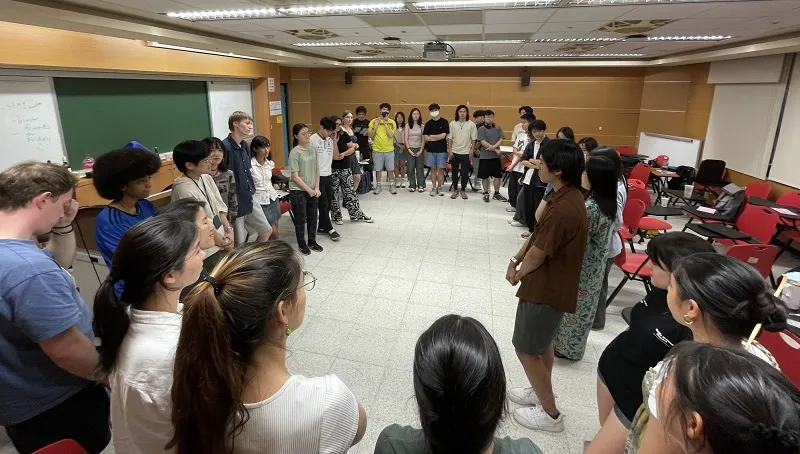
▲We stand up, walk to someone we hadn’t spoken to yet, and simply get to know them.
Yet, this activity was a direct confrontation with Jean-Paul Sartre’s famous line, "Hell is other people," which Professor Kuo used to frame the fear we were stepping into. Sartre’s point was that when we are pinned by the gaze of another, we risk being "frozen" in their view—becoming an object in their world, defined by their biases. In the virtual world, we’ve learned to manage this "objectification" through curated profiles and edited photos, hiding behind digital shields to avoid the risk of being truly seen.
Reclaiming Selfhood
The magic of this classroom activity lay in its power to force a reclamation of selfhood. It functioned as an exercise in mutual recognition, where students were compelled to view one another through a lens of empathy rather than utility. In the simple, sometimes daunting act of holding a conversation, the realization dawned that the person seated across the table was not a "thing" to be feared, nor a metric against which to validate one’s own grades. Instead, they are subjects with their own consciousness, their own fears of being judged, and their own complicated histories.
This shift in perspective explains the deliberate absence of quizzes or exams. When the primary objective is to nurture "readerly and writerly souls," the traditional machinery of ranking becomes obsolete. This quote from the Professor has stayed with me:
"My role is to provide a place where one discovers one’s creativity. A place where we feel like we’re not alone but part of a collective. A place where we identify our moral instincts and are honest about our contradictions. Most of all, in the words of Simone Weil, a place where we learn how to ask another, with the fullness of concentration, 'What are you going through?'"
Radical Empathy: Stepping into the Unknown
Throughout the semester, we dived into migration and asylum, reading legal judgments, watching the mesmerizing film Io Capitano, and reading Violaine Schwartz’s Papers and Tears of Salt.
For someone with little prior knowledge of legal proceedings, being thrust into the roles of asylum applicants and government lawyers felt like an intimidating leap. We spent weeks preparing for an Asylum Law mock trial, focusing on real-life cases of refoulement—the forcible return of refugees to a country where they might face persecution.
I was fortunate to partner with two exchange students from Sciences Po. They helped me navigate the complexities of the law, and thanks to their kindness, my early anxiety gave way to a steady confidence. Together, we worked on the reconstruction of Ioane Teitiota’s asylum application.
The Case of the Sinking Island
Mr. Teitiota’s case is a heartbreaking modern tragedy. He is from Kiribati, a nation where the rising sea level has rendered the land nearly uninhabitable. His case brought the concept of the “Climate Change Refugee” to the UN Human Rights Committee, a category that had never been officially recognized before. Knowing the historical result (that he was eventually deported back to Kiribati) made our task feel even more urgent. As the lawyer for the direct examination, my goal was to create a space where the applicant could fully express his vulnerability. I wanted to humanize a "case" that the system was so determined to keep clinical.
The Friction of the Law
The trials themselves were a masterclass in human contradiction. It was profoundly moving to witness the "beautifully constructed struggles" of my peers. Some students were entirely "in character," their voices carrying the raw desperation of a person fighting for the simple right to exist in a safe place.
However, this empathy was met with necessary, brutal friction. The "government lawyers" were relentless—repeatedly poking holes in stories, challenging credibility, and demanding impossible chains of evidence and paperwork. Seeing my friends inhabit this "brute side" of the law was jarring but essential; it exposed the systemic skepticism that applicants face every day.
This experience brought me back to Franz Kafka’s short story, Before the Law. We realized that the "Law" is often not a destination, but a series of barriers designed to exhaust the traveler. In our trials, we saw how the law treats every case as a file. Yet, for the applicant, that file is their entire life.
A Labor of Empathy
For me, the project I dedicated most of my time to was the semester-long endeavor to produce a ten-page poem in free verse. This wasn't the typical creative writing exercise I was used to. We were challenged to weave a migration story that integrated two opposing forces: an encounter with the law and an encounter with beauty—the persistent, often quiet resilience of the human spirit.
I chose to write about the devastating events in Myanmar, centering on the life of a Burmese activist. Inspired by a documentary of his and many other lives, I found the creative process both rewarding and arduous. It demanded rigorous research into geography, history, and cultural symbols to ensure the details were convincing. Most importantly, I drew from primary sources that provided the raw, heavy emotion I wanted my poem to carry.
I remember hearing whispers of political instability in Myanmar years ago, back in high school. But like so many global crises, it eventually faded into the back of my mind. When the Myanmar Civil War escalated, it was quickly "forgotten," buried in the shadow of conflicts in Ukraine and Gaza. I am grateful for the chance to delve into this forgotten war, using poetry to share the untold stories of ordinary people—of children my age and younger, fighting for a future against the Junta.
The Betrayal of the Earth
I had spent weeks laboring to reach even the halfway point of the poem. Then, as I was deepening my research, the 7.9 magnitude earthquake on March 28, 2025, struck like a physical blow.
My family was in Bangkok at the time; they described a scene of genuine terror. When I learned the epicenter was in Mandalay, my heart went cold. For nearly a century, Myanmar had not experienced a tremor this powerful.
It became agonizing to follow the news. Witnessing the military government manipulate the disaster—issuing false claims of a ceasefire while blocking foreign humanitarian aid—revealed a total disregard for human life. It felt like a betrayal: first by the sky, with the state's jet fighters looming above, then by the earth itself, as if every element had conspired "to deprive them of every possibility of life." This volatile mixture of sorrow, rage, and hopelessness became the catalyst for my title and the final notes of my poem.
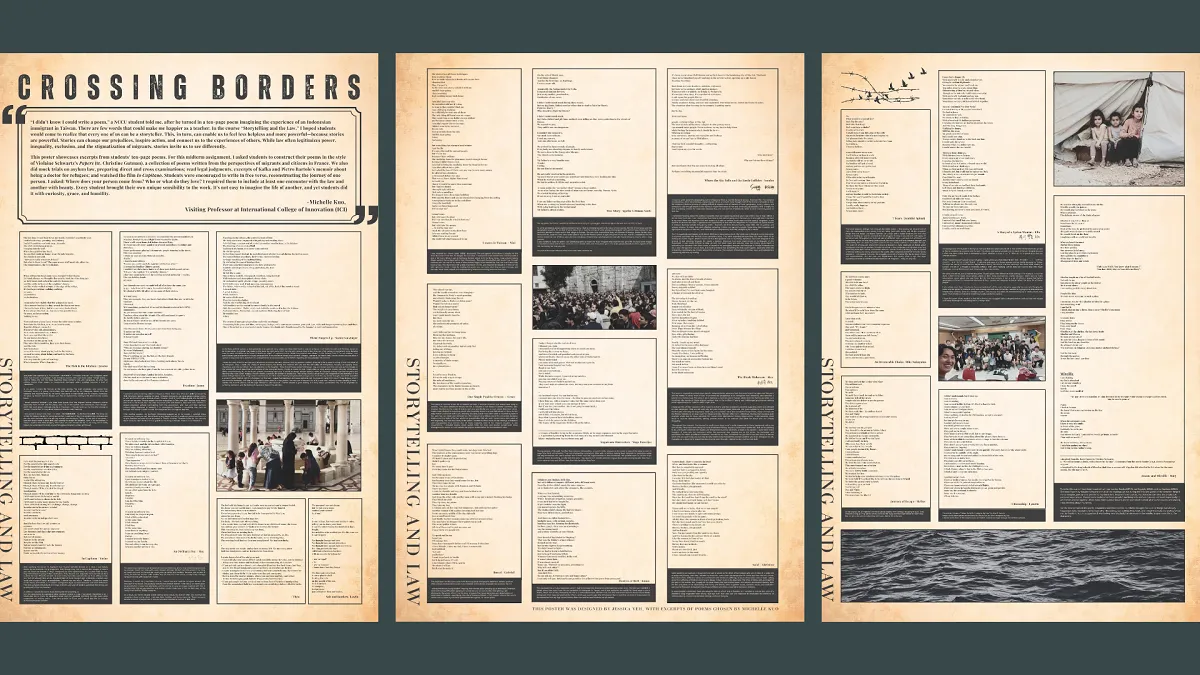
▲A curated selection of student migration poems on display at the Dah Hsian Library
A Gallery of Justice
Our semester culminated in the “NCCU in Connection” Exhibition at the Dah Hsian Library. Given the freedom to explore our own creativity, my peers tackled profound issues: from restorative justice practices in Rwanda to the devastating effects of animal captivity. One group even created a space where visitors could write to the sisters of Lu Cheng, who was wrongfully executed 24 years ago.
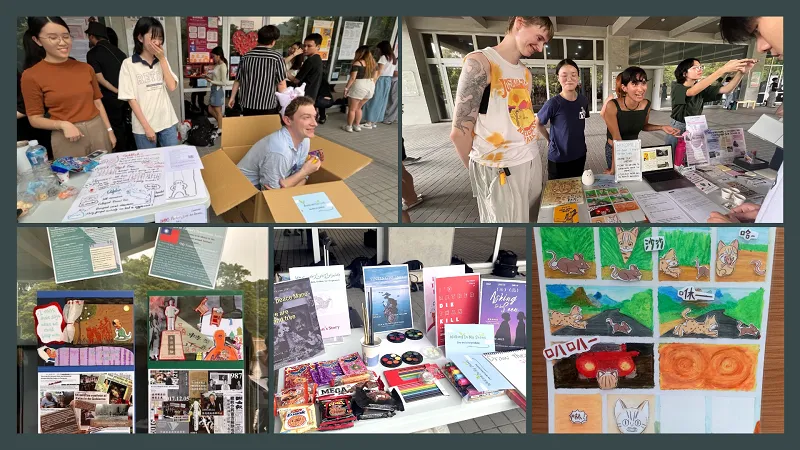
▲Given the freedom to explore our own creativity, students tackled profound issues, including animal rights, transitional justice, and the complexities of wrongful convictions
Muted Rhapsody: A Love Song to the Mother Tongue
The music video 尾蝶仔飛轉來 (Fly Back, My Butterfly) was a deeply personal collaboration with my classmate, Christine. She composed and sang the haunting melody in Taiwanese Hokkien and a line of the Thai Northern Dialect (both of my mother tongues, which I unfortunately cannot speak), while I digitally painted the entire visual narrative. Together, we explored how Taiwan’s history of martial law and the National Language Movement (國語運動) led to the erosion of mother tongues, creating lasting generational barriers.
We chose butterflies as our central symbol—representing mother tongues as fragile, vibrant entities seeking the freedom to fly back into our mouths to be sung once again. We wanted this project to act as a vessel for Transitional Justice, motivating others to reconnect with their heritage.
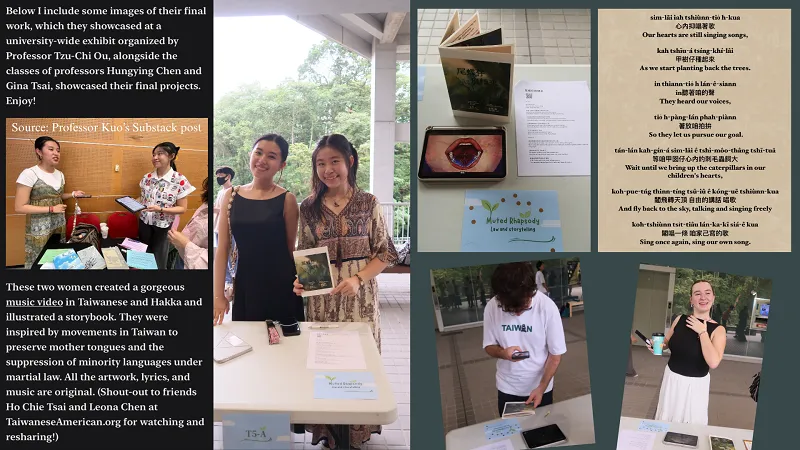
▲Scenes and digital close-ups from the exhibition display of the Muted Rhapsody: A Love Song to the Mother Tongue
The process was intense. There were times I truly struggled with my own perfectionism, but an invisible hand seemed to push me through the exhaustion. I stayed up the entire night before the exhibition, meticulously digital-painting the artworks for the video while we finalized the edit. Surprisingly, I found myself enjoying every part of the labor. I realized that the act of "creating for myself" is a soul-nurturing and deeply fulfilling process.
Looking back, this course was more than a series of lectures. It was a journey of dismantling the screens we hide behind, facing the "friction" of the world with empathy, and ultimately, finding the courage to sing and paint our own truths.