For a little over two weeks, the island of Taiwan felt like it was holding its breath underwater. The relentless late-September rains weren’t the usual tropical downpours familiar to us in the Wenshan district of National Chengchi University. They were a ceaseless, heavy drumming that turned streets into shimmering canals and mountainsides into soaked sponges. As the clouds refused to break, a creeping anxiety began to take hold. The kind that arises when the line between persistent weather and true disaster begins to blur.
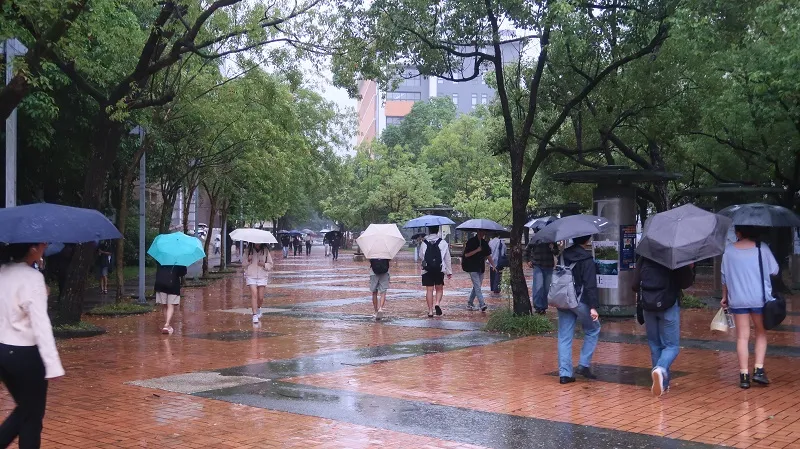
▲A rainy day on campus (photo by Sandra)
The Catastrophe: A Tsunami in the Mountains
In late September, Super Typhoon Ragasa tore across the Philippines, passed Taiwan, and headed toward China. When it struck eastern Taiwan, Guangfu Township (光復) in Hualien was among the hardest-hit areas. On September 23, the breach of the Mata’an Creek barrier lake (馬太鞍溪) unleashed a massive, muddy torrent known as the ‘tsunami in the mountains’ that swallowed the entire neighborhoods. Homes, streets, and memories disappeared overnight. Nineteen lives were lost, six people went missing, and a community was left in ruins, buried under thick layers of mud.
In the aftermath, local authorities faced heavy criticism for issuing delayed warnings despite prior knowledge that the nearby lake was vulnerable to collapse during heavy rainfall. Survivors in Guangfu reported that they received no warning from the authorities before the disaster. Yet, amid the destruction and political fallout, an extraordinary force emerged, showcasing the compassion and unity of ordinary Taiwanese.
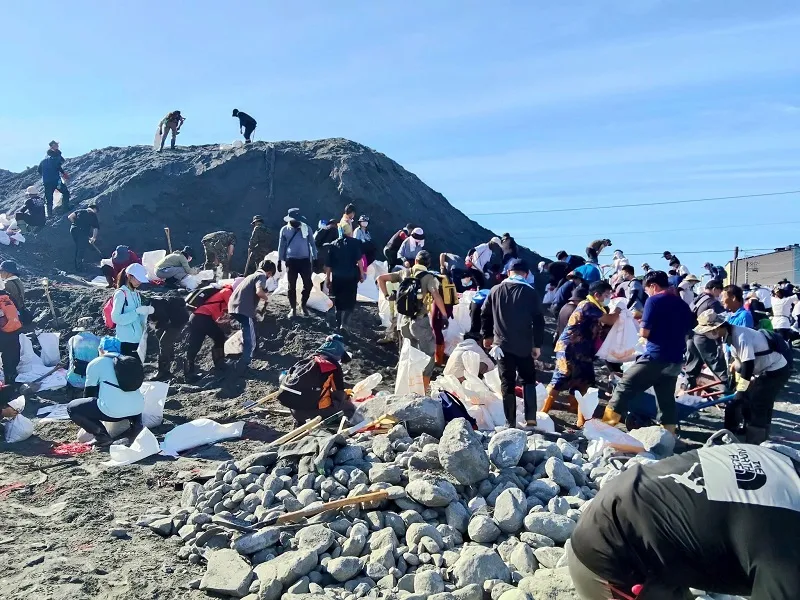
▲Shovel Superheroes clearing up the space, meticulously shoving mud into plastic bags (photo courtesy of Angela Lin, a friend of mine who joined the volunteer effort)
Societal Mobilization: Taiwan’s Resistance
In the immediate aftermath of the disaster, a grassroots movement known as the “Shovel Superheroes” (鏟子超人) phenomenon began to take shape. Without waiting for official instructions, over 100,000 volunteers who transcended age, nationality, background, and distance from across Taiwan all boarded trains to Guangfu Station, showing up with their rain boots and shovels ready to make a change. During the Mid-Autumn and Double Tenth Day (National Day) long holiday weekend alone, more than 30,000 people arrived to help.
A first-hand reflection from 紀淵懷 (Polaris), a Taiwanese NCCU student who joined during the three-day Teacher’s Day break, encapsulates this emotional unity. As soon as news of the disaster broke, he rushed to buy a pair of boots, a shovel, and a ticket to Hualien. “The mud felt like half-set concrete, sticky and thick,” he recalled. “Every shovelful was a struggle, and my boots kept getting sucked off my feet.” Polaris joined a team of volunteers he met that very morning, spending an entire day clearing out a single home. Later, a local guesthouse owner offered Polaris and his team free accommodation, a gesture of kindness that mirrored the solidarity spreading through the community.
Beyond the shovels and buckets, others worked behind the scenes to keep the effort alive. Self-organized teams prepared hot meals, handed out bottled water, offered medical care and rides, and gathered supplies which were all offered freely by people who simply wanted to help. They were affectionately nicknamed, for instance, “消毒超人” (disinfection heroes) and “按摩超人” (massage heroes).
Once again, the island lived up to its well-known saying:
「台灣最美的風景是人情味」—“The most beautiful scenery in Taiwan is its people.”
Stories of "Shovel Superheroes" from NCCU Students – From the Philippines to Hualien: Rania’s Personal Connection to Crisis
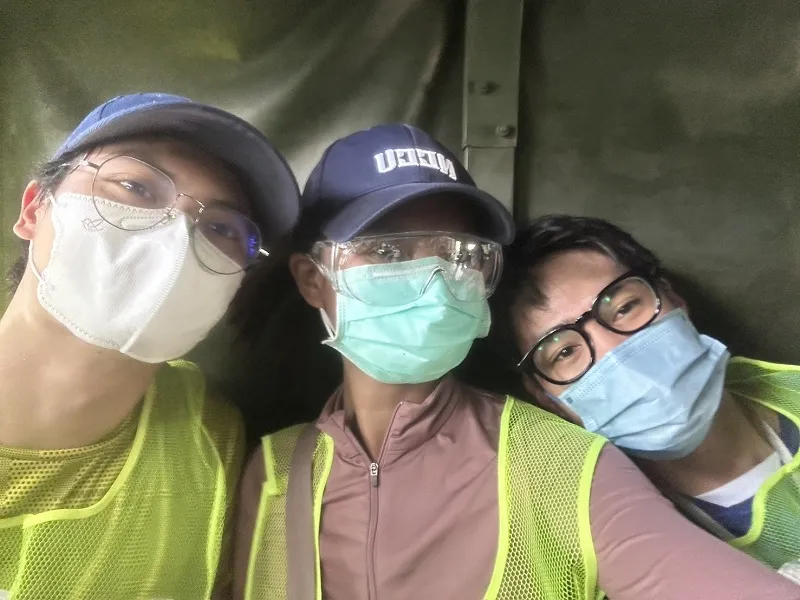
▲Rania (middle) along with her Filipino friends
(Photos in this section are courtesy of Rania)
Shortly after the news broke out, thousands of volunteers rushed to the disaster zone. Among them was Rania Katherine Salim, currently a senior at the International College of Innovation (ICI) from the Philippines.
Rania’s decision to travel to the disaster site in Guangfu Township was immediate and deeply personal. She joined a group of over 70 volunteers organized by Chef Timothy Lu of Pasta and Co., after seeing a call for volunteers on the Foreigners in Taiwan Facebook group.
“Honestly, I just wanted to spend my time doing something meaningful,” Rania explains. “The situation in Hualien hit close to home. Seeing how badly the indigenous towns were affected reminded me of how disaster-prone the Philippines is, and how often people there get left behind.” The same tropical cyclone had inflicted a severe crisis across the Philippines, causing 11 deaths, devastating floods, and agricultural damage that fueled warnings of food shortages.
For Rania, volunteering in Taiwan was a way to act on a frustration she felt about her home country, where natural disasters are frequent but large-scale, organized volunteer movements are often stifled by corruption. “I couldn’t help in the Philippines physically right now, but at least I could do something here. That was the driving force.”
When Rania arrived on October 3rd, her first impression was overwhelming. While the main roads near Guangfu station were clearing, the volunteer effort itself was ‘driven by individual initiative rather than top-down organization.’
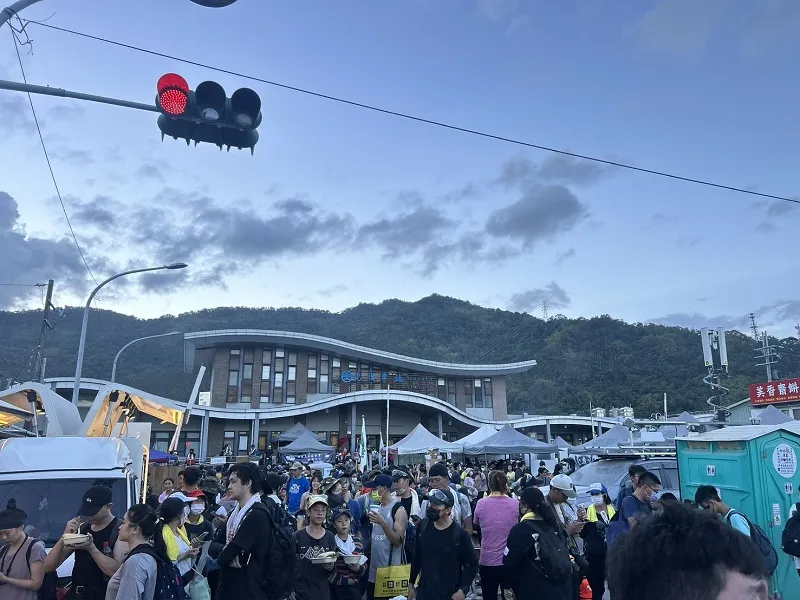
▲Outside of Guangfu Station, many tables were set up full of supplies for the volunteers
“When we first arrived, it was a bit disorganized. At least for us, we didn’t really have a clue where to go and what to do.” Rania recounts with a laugh. “One funny scenario was our volunteer team (mostly expats) set up a food booth right next to the Tzu Chi Foundation. We were serving meat, and Buddhists are vegetarians. So, at first, there were some conflicts regarding the logistics. Everyone was there to help, but getting into conflicts over different affiliations was a bit absurd to me.”
Eventually, Rania’s group gave up on assisting at the food booth as there were already enough people there, and was directed to an even more immersive experience. They hopped onto a military truck bound for Dama Village (大馬村), about a five-minute drive from the station. There, Rania joined 50 to 80 others clearing a choked canal.
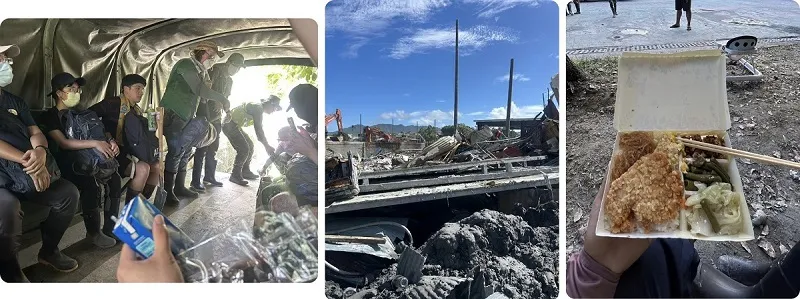
▲Military truck navigating the mud-choked ruins of buildings; Rania’s the bento box
Despite the chaos and physical exhaustion, Rania found moments of profound connection that defined her experience. After a long morning of shoveling, volunteers gathered for a late meal. “We got a bento box from other volunteers, and it was one of the best meals I have ever had,” Rania recalls. “It wasn't just food. It was made with such compassion and camaraderie.”
She paused before adding, “There was also one moment I clearly remember. We were washing off the thick mud from our boots when I saw a cleaning station where people would clean your boots for you. Seeing people kneel and wash the boots of other volunteers was such a significant moment for me as a Christian because it reminded me of Jesus washing the disciples’ feet. I don’t want to get too religious or cultural, but washing a stranger’s foot is not something we see every day. It was a very heartwarming moment because you could really feel the sense of volunteerism from everybody.” This selfless act, stripped of any cultural or religious boundary, was the essence of the day.
Reflections Beyond Borders
Rania’s Filipino background offered a unique comparative perspective on disaster response. “Taiwan has this grand movement where volunteers show up en masse to rebuild,” she notes. “I know it’s not logistically possible to have that back home. My parents, who work in law enforcement, have shared stories of donations being misused. That's likely why such a grand volunteering movement hasn't flourished there.”
As an international student, Rania felt the language barrier. “If I had gone by myself, I would definitely have problems with the language,” she admitted. She relied on a Filipino friend who could speak Chinese for translation and even asked about the meaning of "辛苦了", which is a common Chinese phrase to thank someone for their hard work and effort. “We also didn’t really get a chance to meet the locals, but maybe it’s because we couldn’t even identify who the locals were and who the volunteers were,” Rania said with regret. Despite the initial disorganization and communication barriers, Rania’s core takeaway was the sense of community.
Ian’s Story
Among other international students from NCCU who joined the relief effort was 高赫柱 (Ian), currently a senior in the Department of Radio and Television from South Korea. Ian’s experience, like Rania’s, offers a unique window into the immediacy, compassion, and sometimes chaotic beauty of grassroots civic action.
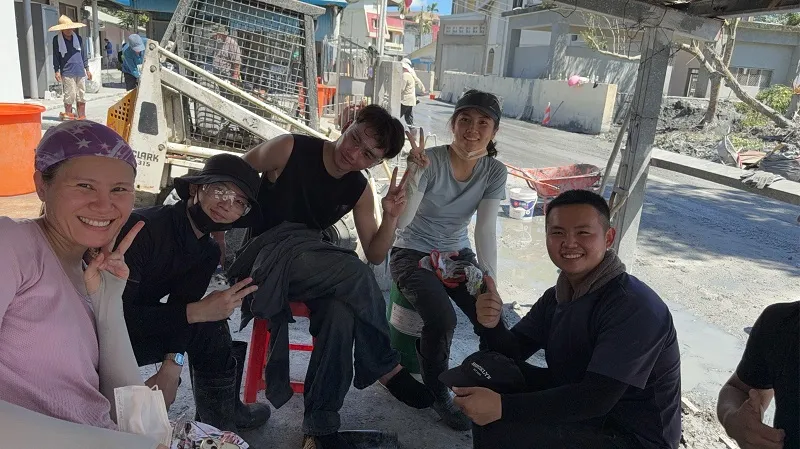
▲Ian along with his university friends during a break from the physical labor
(Photos in this section are courtesy of Ian)
Ian and a group of university friends traveled to Hualien on October 5th. His reason for going was simple and reflective of the general mood across the island – seeing an opportunity to contribute.
“I happened to have nothing planned for the Mid-Autumn Festival break, and I saw that so many people were getting involved,” he explains, reflecting the general mood across the island. “It was a relatively spontaneous decision to go down and help.”
His first sight upon arriving near the volunteer sign-up area was both humbling and energizing. “Seeing supplies being handed out and realizing people had traveled from all over the country to help made me feel both moved and nervous."
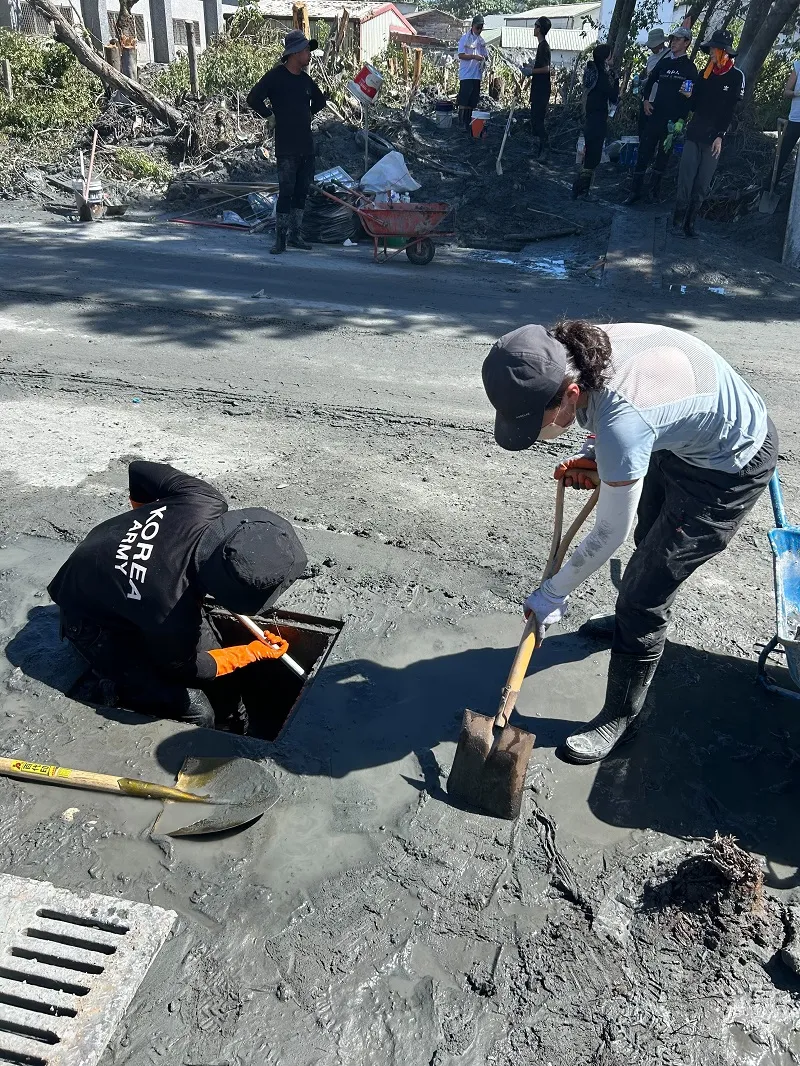
▲Ian is cleaning the drainage ditches with the help of a spoon offered by residents
Ian’s team spent their entire day on one of the most urgent and physically demanding tasks which was clearing the drainage canals. The challenge wasn't just the sheer amount of sludge, but the lack of proper tools for certain jobs. “Some of the drainage ditches were incredibly narrow, and a regular shovel was useless. The kind owner of a nearby restaurant noticed our struggle and actually offered us their large soup spoons to use. It turned out to be the perfect tool! They were great for digging in those tight spaces,” he said, recalling his most memorable moment of local ingenuity and warmth.
As an international student, Ian faced logistical and communication hurdles. Initially, he wanted to stay two days, but difficulty finding lodging forced a change to a single-day trip. He also found that while the desire to help was widespread, the organization was very grassroots.
“At first, there was just so much information floating around,” he recalls. “But I found that many people shared the same interest in helping, so a lot of problems became easier to solve through cooperation.”
He and his team had heartwarming interactions with the residents, particularly the indigenous community members. “Even in the midst of their suffering, the locals were constantly offering drinks and meals to the volunteers. We chatted happily. They were really optimistic and strong-willed. Their spirit was truly impressive.”
Like Rania, this was also his first experience doing disaster relief work outside his home country. “It made me realize that helping others goes beyond nationality,” he reflected. He also hopes more students will see that disaster relief doesn’t require professional expertise. “There are many ways to help on-site. Don’t underestimate your own ability,” he states. He concludes with a message of hope and commitment, “I truly hope events like this never happen again. But if they do, I am willing to go again. I hope more people can join in.”
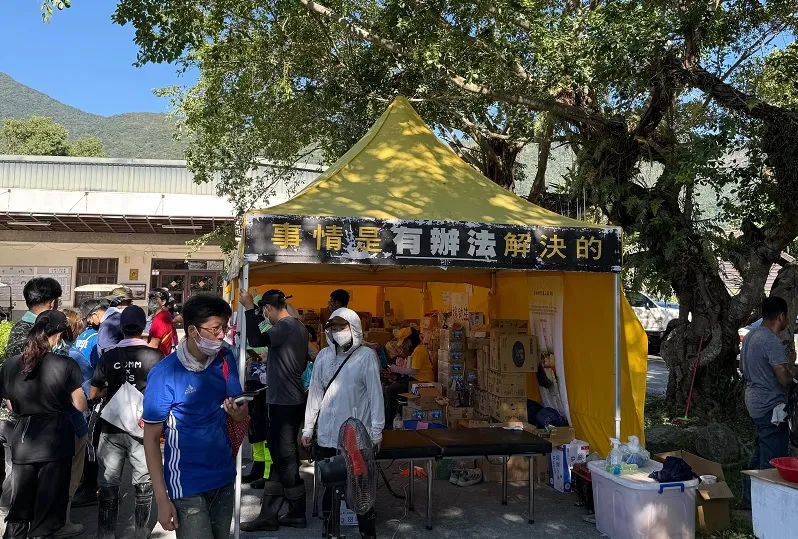
▲A hopeful message printed on the tent: 「事情是有辦法解決的」“Things have a way of working out”
Seizing the Moment
Taiwanese sophomore 吳翌誠, from the Department of Finance, joined his classmates on a volunteer trip to Hualien on October 4. His reflection captures both the warmth of community spirit and the practical frustrations that accompany disaster relief.
For Yi-Cheng, the decision to volunteer was driven by a youthful urge to contribute meaningfully. “I already wanted to go help, to do something while I’m young that I won’t regret later,” he says. The initial hurdle was finding companions, but once he discovered friends shared the same resolve, their plan quickly took shape.
“When we got off the bus, the scene felt very chaotic. Even though the military was there to direct traffic, there was no clear work assignment,” Yi-Cheng recalls. “They dropped us off near a temple and just told us to patrol the streets, find a place that needed help, and go in ourselves. We walked a long distance before finding a place that needed immediate attention, which felt like a waste of precious energy.”
This experience led to a critique of the top-down management. “I felt the command system was inefficient. They should have had a more effective way to manage the flow of volunteers.”
Connecting with a Stranger’s Home
Yi-Cheng and his friends primarily spent their time using shovels to clear thick mud from inside damaged homes. His most indelible memory centered on a deeply personal space. “We spent a long time digging out a tatami room that was filled with mud. It was incredibly hot and stuffy inside,” he shares. Although they couldn't finish clearing the entire room, the effort provided a profound sense of achievement.
More than the physical work, the connection with the homeowner proved transformative. They learned that the tatami room belonged to the owner’s late mother. Yi-Cheng felt that their work allowed the elderly woman, in a spiritual sense, to finally have a "home to sleep in" again. “Before we left, we took a photo with the family and even paid our respects at the grandmother's shrine,” he says. “We felt a genuine connection forming with this family that had been strangers just hours before.”
Despite the initial organizational difficulties, Yi-Cheng was deeply moved by the outpouring of support across Taiwan. “Along the way, there were so many volunteers handing out supplies or helping others,” he notes. “I truly felt the strong sense of 人情味 (human touch/warmth) that Taiwan is known for.”
Small actions and memorable connections are human experiences that underscore the essence of humanity amidst depressing situations.
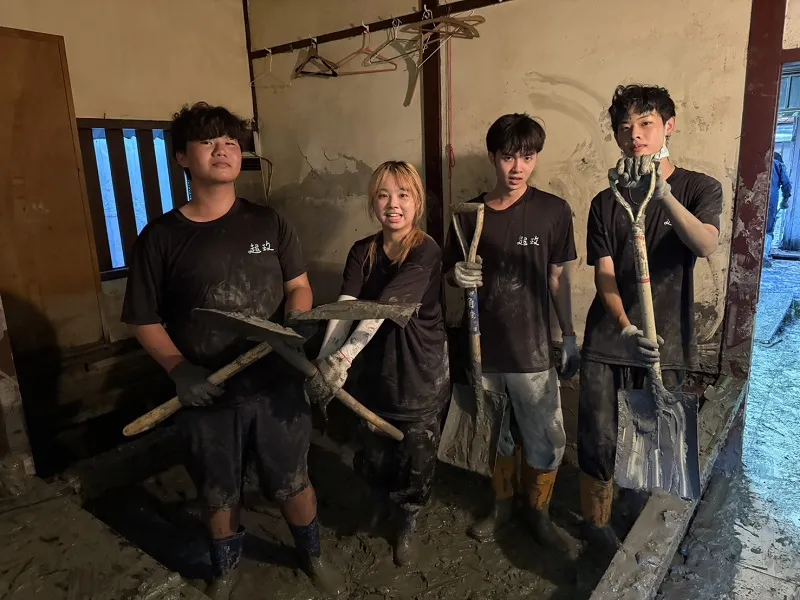
▲After hours of digging through mud, Yi-Cheng and his team pause for a photo inside the tatami room they helped bring back to life.
Mobilizing the Next Generation
Universities across Taiwan also stepped up to support this wave of civic engagement. At NCCU, administrators encouraged students to take part in volunteer efforts while ensuring their safety and well-being. The university announced an initiative providing insurance coverage and transportation subsidies for those traveling to Hualien, through the Hualien Mataian Disaster Relief Service Recognition subsidy program. Students could apply for insurance through the Freshman College Office (新生書院) three days before departure, and later reimburse their round-trip train tickets between Taipei and Hualien upon returning. (Applications were open until October 31, 2025)
Student organizations such as the NCCU Service Club played a key role in mobilizing participation, sharing information, coordinating small groups, and connecting those who wanted to help but didn’t know how to begin. Their efforts reflected a growing awareness within campus communities, extending education beyond classrooms.
Conclusion
The stories from these NCCU students collectively illustrate a profound truth: at the core of every crisis, the most powerful force is society’s collective will to care. This massive, though sometimes messy, grassroots mobilization is where our generation finds its purpose. The sheer energy of young people provides the sustained physical effort needed for long-term recovery, while our fresh perspective can help address logistical gaps and push for more efficient systems.
The flood may have buried homes, but it uncovered something far deeper, the collective heart of an island that stands together in times of crisis. The “Shovel Superheroes” movement not only cleared the mud left behind by the storm but also revealed the enduring strength, resilience, and kindness that continue to define Taiwan.
News Sources
Guardian News and Media. (2025, October 1). Gym Bros, monks, retirees: Thousands descend on Taiwan town to clean up after devastating flood. The Guardian. https://www.theguardian.com/world/2025/oct/02/thousands-descend-taiwan-town-clean-up-after-devastating-flood--gym-bros-monks-retirees
BBC. (n.d.). Ragasa: “no warning”, say Taiwan residents after Typhoon Bursts mountain lake. BBC News. https://www.bbc.com/news/articles/c2ejpwmen7jo.amp