by Ruby Dalmer
On Saturday, 24 May, 2025, 17 other National Chengchi University international students and I set off on a day-long adventure to Luodong Senior High School in Yilan County. Excited yet uncertain for exactly what was to come, our group set off from Taipei armed with open minds and collective curiosity.
The Luodong Senior High School/National Chengchi University cultural exchange is designed to promote meaningful collaboration between students through activities which foster mutual understanding. A transformative sharing and blending of cultures is on offer — benefitting both sides in the process.
After a sleepy early morning journey, we were snapped out of our slumber as our bus rolled into Luodong High School to a heartwarming grand welcome. Half-awake turned into fully alert as we were met with a chorus of “Welcome/歡迎光臨“ by our kind hosts. The students had even written our Chinese names on individual goodie bags with a series of touching gifts hidden within. On top of this, the students had also printed out our country flags for easy coordination.
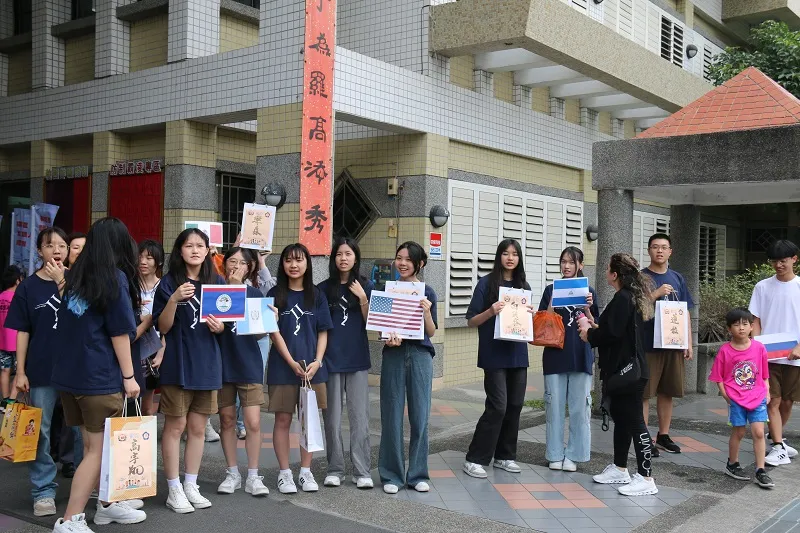
▲The students had even written our Chinese names on individual goodie bags with a series of touching gifts hidden within.
Our simple job of locating our flag and bonding with our respective teams of flag bearers was the first taste of the meaningful cultural exchange to come. After bonding with my group of girls carrying the New Zealand flag, we were all ushered into the High School auditorium to start the presentations.
We kicked things off by hearing some amazing introductory presentations from the Luodong High School students. The two programs in attendance: the Bilingual English Program, and the Humanities and Social Sciences Program, each gave brilliant run-downs of who they are, what they do, and what they hoped to get out of the event.
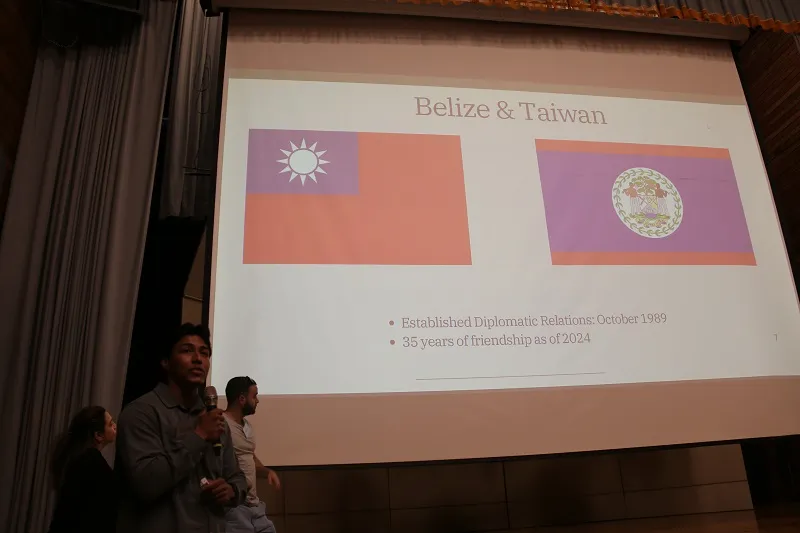
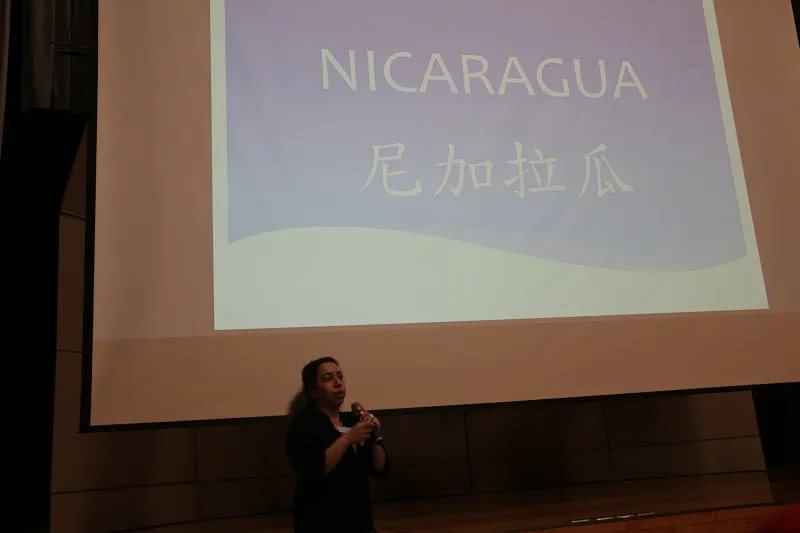
▲The international students give presentations to share their respective countries and cultures.
Next up, it was time for the international students to give our presentations sharing our respective countries and cultures. We were split up by region of the world — taking to the stage one continental landmass at a time.
Latin America started us off — sharing stories and facts from Belize, Guatemala, and Nicaragua. Then we had Europe — repping France, Germany, and Italy. Asia was represented too — diving deep into the histories and eccentricities of Singapore, Vietnam, Indonesia, and the Philippines. The final continent is a mythical continent — a union of the rag-tag leftover three countries that have comically zero connective tissue — the United States, Russia, and New Zealand.
I took away some truly golden nuggets of insight from these presentations. For example, I learnt that you can celebrate New Years Eve 10 times in one night if you travel (on a frightening bender) through each of Russia’s vast time zones. I also uncovered the existence of ‘Chocolate Hills’ in the Philippines — which are oddly shaped mountains covered in green grass that turn a chocolate-brown during the dry season.
My contribution to this international bonanza was sharing and attempting (after much practice) to pronounce New Zealand’s longest Māori place name: Taumatawhakatangihangakoauauotamateaturipukakapikimaungahoronukupokaiwhenuakitanatahu — yes, it’s a mouthful!
After these colourful introductions, we had all worked up an appetite. It was then on to the buses with one clear mission — lunch. We journeyed to Datong Township to have an Indigenous culinary experience. We were served a mouthwatering array of local Atayal Tribe delicacies.
The combination of flavours and textures on offer were all delicious. It was really special to see people from all over the world enjoy this food they might not have otherwise ever tried.
Over lunch, we sat with the high school students and got to know each other in greater depth. We shared stories and learnt about each others’ lives. During this time, I was honoured to sit down with two amazing young girls, Anne and Lisa. Both 17 and in the Humanities and Social Sciences Program, they allowed me to ask them some questions about the cultural exchange.
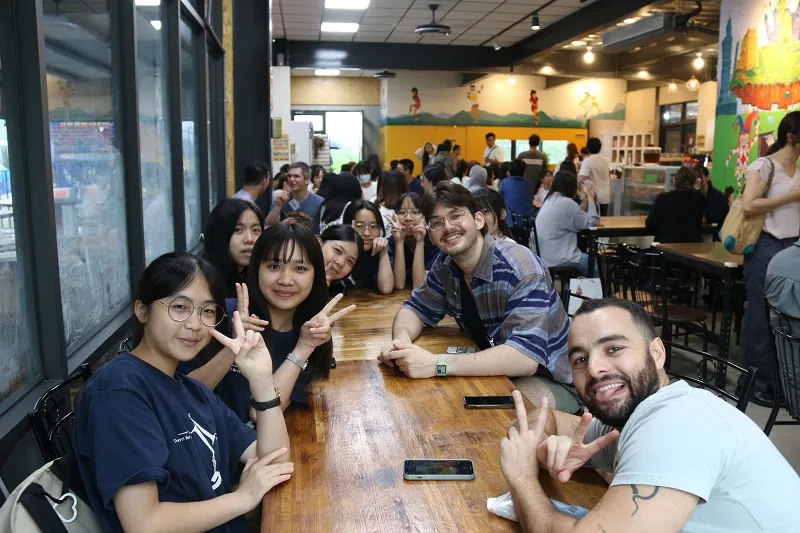
▲Over lunch, we sat with the high school students and got to know each other in greater depth.
When asking about their motivations for joining the activity, Anne said — “Talking with people from other countries is how we can know more things about the world — and also using English to talk with others is quite interesting for me. We are using the things we have learned in the world — not just in theory”.
Lisa echoed Anne’s thinking — emphasising how learning about and interacting with the world can help situate Taiwan in a broader context. In Lisa’s words, “I want to know how other people see us and think about us — not only how we perceive ourselves”.
After enjoying the delicious food and chatting with our new friends, it was time to move to our next location. For our afternoon activities, we were headed to the Atayal Life Museum — a cultural centre for the Atayal Tribe.
At the Atayal Museum, we cycled through a series of equal-parts fun and educational activities. My group started on a major high — learning dance moves and choreography under the teachings of the Atayal community’s resident dance instructor.
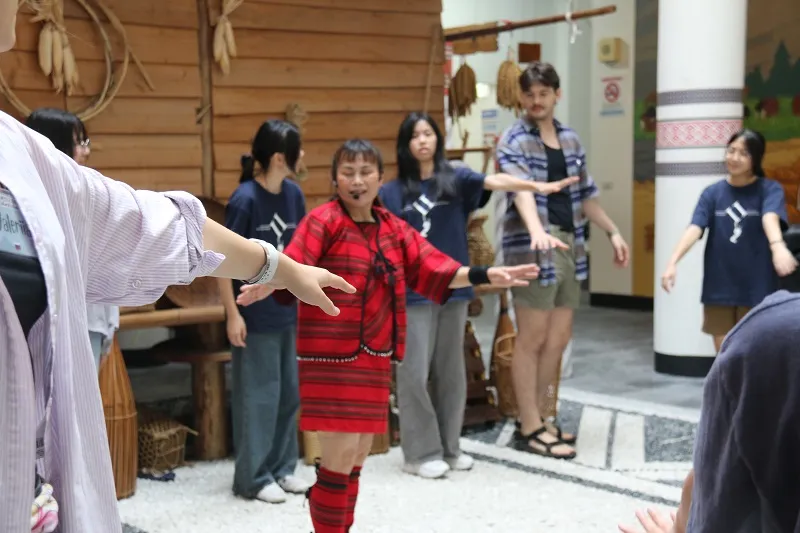
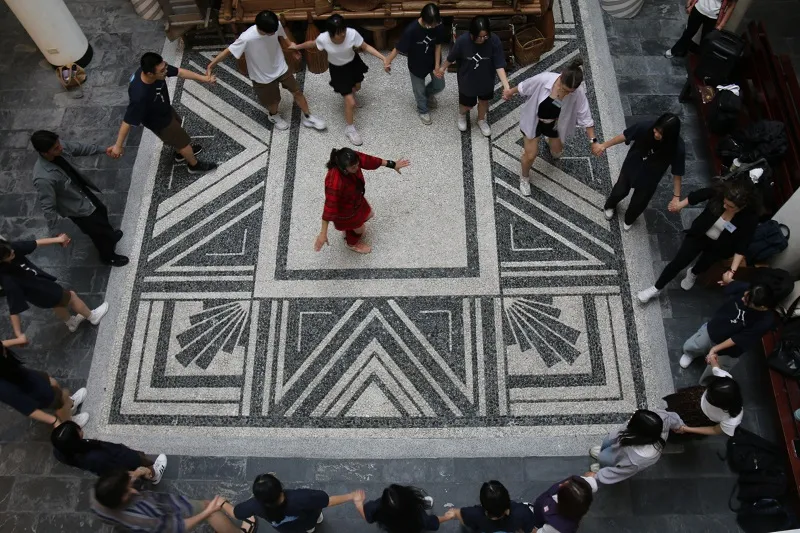
▲My group started on a major high — learning dance moves and choreography under the teachings of the Atayal community’s resident dance instructor.
With admittedly varying degrees of natural dance talent, my group gave it our all. It was a chance to put these new friendships to the test — relying on each other for the flow of the dance performance. The instructor was kind and warm — granting us endless patience even when we fumbled her moves.
After retiring our short-lived Atayal dance careers, we moved on to the next station. We relocated to a lecture-style room to watch a short documentary about Atayal life.
This was a standout moment for me. It was incredible to see traditional ways of Atayal community organisation communicated through the art of storytelling and cinema. A cool extra element was that the documentary was in the Atayal language — meaning the Luodong students and ourselves were united in reading the subtitles as guests in the culture.
Next up after the cinema was a beading workshop. We were tasked with weaving beads through a charm in an Atatyal pattern designed to reflect the harvest. I found it surprisingly meditative — a special kind of focus and peace. The elders showed us the ropes and joked around with us when we sometimes muddled the pattern or tied a particularly hideous looking knot.
Armed with a beautiful new bag charm, it was now time for free time. We were given around 30 minutes to ourselves to wander around the museum. We looked at the incredible art on offer, bonded with the high school students, and reflected on the activities of the day so far.
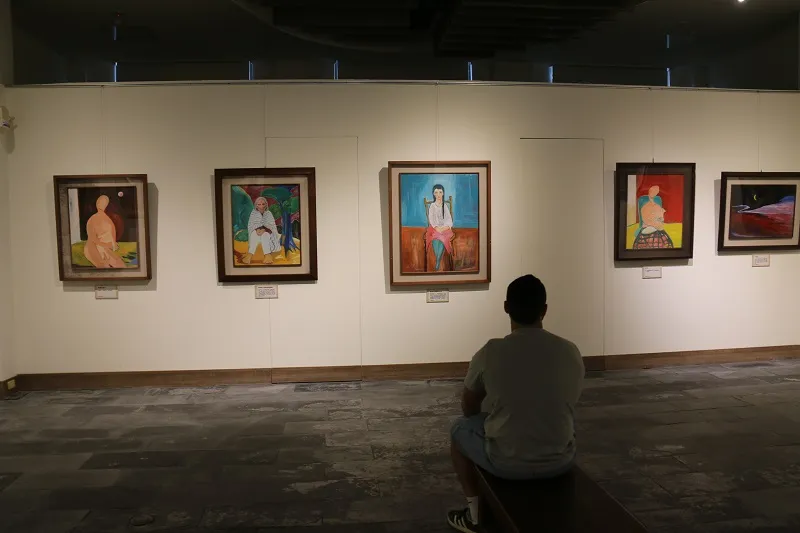
▲ We looked at the incredible art on offer, bonded with the high school students, and reflected on the activities of the day so far.
Before we left the museum, we were able to do something truly special — try on traditional Atayal clothing. Being dressed by a member of the Atayal community was an honour I will never forget. We all felt so lucky to have had such gracious hosts who made us feel so welcomed and comfortable.
Understanding the clothing is also a great gateway into understanding the culture. For example, the kinds of baskets or carrying bags we were assigned denoted different roles and responsibilities within the community.
Before we knew it, it was time to say goodbye to the Atayal Life Museum. We retreated back to the bus and moved on to the final stop: a famous roadside food vendor. This vendor is well-known in Yilan County for a vast array of delicious delights. I tried this wonderful icy sweet-and-sour mango dessert — very refreshing!
After our day of fun together, saying goodbye to our new friends was bittersweet. After many photos and several instagrams exchanged, we had to part ways.
We kicked off the bus ride back to NCCU with a surprising and rather hilarious food auction. The leftover lunch food was pawned off to us international students in a fabulous bidding war. I emerged satisfied with my loot of one banana rice roll.
While on the bus, we had a chance to reflect on the day. We found common consensus in the deeply enriching nature of the experience.
For Isma (France), the major highlight was the movie at the Atayal Museum. “I loved the movie. I learned a lot from that. It’s something I’m grateful to have been able to do before leaving Taiwan”, she says.
Mateo (Guatemala) was grateful for the experience to get to know a more intimate side of Taiwan and Taiwanese people. “Taiwanese people can be quite shy and timid so it can be hard to get to know them. So when they make an event specifically like this, Taiwanese are very keen to talk to foreigners”, he says.
Mateo also reflected on how impressive the kids at Luodong Senior High School were. He was struck by not only how good their language ability is, but also how proud they are to come from Taiwan. In his words, “They love their home. They want to do their part for Taiwan. I always find that fascinating — especially because I have complicated feelings towards my own country”.
Arriving back at NCCU, we were a different bus of people than had set off that morning. From so many disparate corners of the world, we are all connected by a deep desire to learn about new places and people. What we discovered is that the students at Luodong High School share this core ambition. And with a shared motive as fundamental as that, the possibility for connection is endless.