By Angela Glowacki
A chance to study abroad brings a multitude of opportunities for both personal and academic growth, no matter how long you spend in your host country. NCCU hosts international students from all over the world from anywhere from one semester to four (sometimes even more) years.
As a degree student embarking on a two-year program, I first came to Taiwan unsure of what would lie ahead, but eager to see what the next two years would bring. During my first semester I met several international students who were also starting their first semester in Taiwan, both semester exchange students and degree students.
From my friendships formed with both exchange and degree students I became interested in hearing the similarities and differences of their experiences and I had some assumptions that I wanted to explore. 5 months versus at least 2 years is a drastic difference in time spent abroad. When my exchange friends left after my first semester, I couldn’t imagine how I would have felt if I was leaving with them. At that point, there still seemed to be so much of Taiwan left to explore and it felt like I was just beginning.
I can’t speak for other degree students but for me personally, the first semester in Taiwan felt like the beginning tutorial portion of a video game – the part where you can jump off as many ledges and die as you want, over and over, until you get your bearings and are ready to play the game for real. My first semester was defined by silent meltdowns in the library because I couldn’t figure out how to print things and fumbling over my bubble tea order in broken Mandarin. These struggles, though frustrating, were also formative. If I had left in January, of course I would have felt satisfaction for completing my time abroad, but I wouldn’t have had much time to really experience the growth and progress I made adjusting to my new life. I wanted to see what other exchange and degree students had to say about their experiences, so I sent them a short survey asking them to reflect on their time abroad for different durations.
A theme that emerged from the survey was the role of language in shaping the study abroad experience. Both exchange and degree students acknowledged the importance of learning Chinese, but their perspectives varied based on the length of their stay. One degree student brought up their language ability and made an interesting observation between the usefulness of language ability between different time frames:
“I think my experience would be a lot richer if I knew Chinese before coming! For just an exchange, I don’t think it’s necessary, but for a degree seeking student I think it would help a lot.” - Degree student
Many exchange students and degree students take language classes during their stay at NCCU. Though they all experience varying levels of growth in their language ability. Certainly, staying longer will result in more advancement in the language.
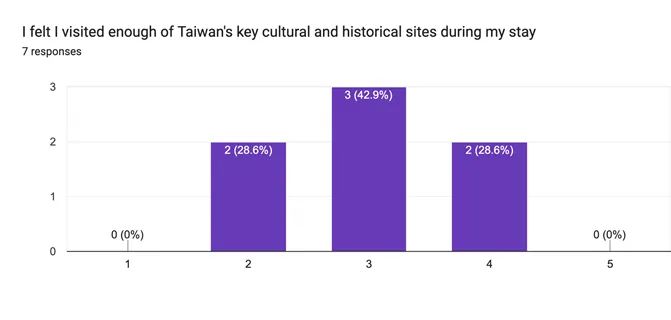
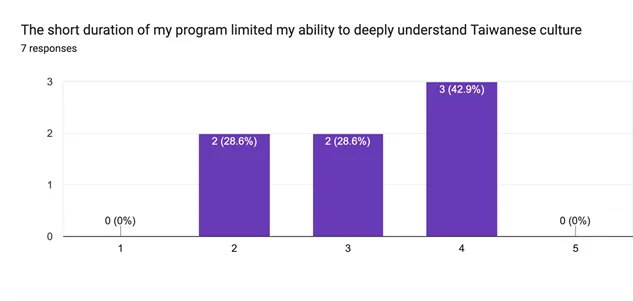
Several exchange students commented on how time was a limiting factor during their exchange in Taiwan. While their experiences were often intense and memorable, many expressed a desire for more time to explore Taiwan and immerse themselves in its culture.
“I wish I had more time to visit the island in its entirety and experience more of Taiwanese culture.” - Exchange student
“I know the international office would send us quite regular invitations to events that looked really interesting! But unfortunately I always had something else planned. I wish I could have put these events in a higher priority.” - Exchange student
From these responses, the challenges of time constraint were illuminated. This was reflected in some of the survey responses, included below.
After reflecting on the various responses I received I came to a few conclusions about the differences and similarities between the experiences of degree and exchange students. The first is in regards to the meaning the students find from their time abroad. Both degree and exchange students remarked that they formed connections and had meaningful experiences and friendships while abroad. However, degree students often noted the additional depth that comes with extended time to build connections.
“My extended stay in Taiwan has allowed me additional time and opportunities to cultivate personal relationships and further immerse myself in the country/culture … These relationships have enriched my experience in Taiwan by expanding my cultural perspective and developing an additional support system while living abroad.” - Degree student
In contrast, exchange students appreciated the intensity of their shorter programs, even while acknowledging the limitations.
“I stayed for a whole year, so it’s not a short time. But I wish I had more time to learn the language further and experience more of the local culture. Granted, the length of time is not the only factor. Being surrounded by other foreign students is also limiting … But I had the best time of my life in Taiwan and have no regrets. The experience as a degree student would certainly have been different, but the intensity of the exchange was memorable.” - Exchange student
Degree students provided mixed responses when asked whether they felt stagnant or no longer challenged after extended stays in Taiwan. This reflects an interesting aspect of long term international experiences: the shift from initial excitement and culture shock to a more settled routine.
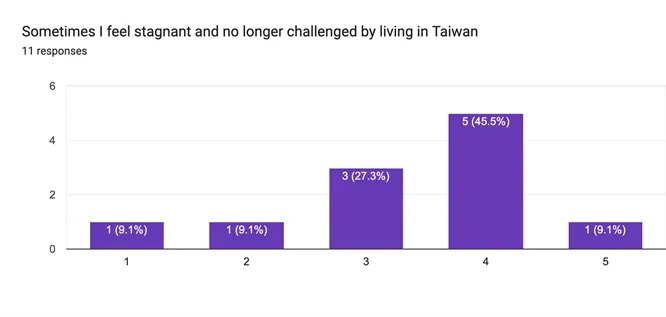
I was surprised by the spread of responses, but I think it encapsulates an interesting experience that long term international students face abroad. In my own experience, while I wouldn’t say I necessarily feel no longer challenged by Taiwan, I do sometimes feel a sense of routine settling in, where the initial novelty has worn off, and daily life feels more predictable. This isn’t a bad thing – comfort and familiarity are signs that I’ve adapted to a new environment and it’s something I’m proud of. The intense learning curve and constant stimulation that defined my first few months gradually gave way to a steadier rhythm.
For degree students, this sense of routine can feel stagnant, especially if they don’t actively push themselves to engage with new cultural or academic challenges. Others may see it as an opportunity to delve deeper into aspects of life in Taiwan that they might have overlooked initially - like forming closer relationships with locals, learning the language more fluently, or exploring more cultural practices. This phase of adjustment reflects a shift from surviving and adapting to thriving and integrating, and whether it feels like stagnation or growth often depends on personal outlook and the effort invested in continuing to learn and engage with the environment.
Ultimately, I came to the conclusion that there are different types of growth. There is the growth you get after one semester where you go through culture shock, get used to living in a foreign country, and pack as much exploration into the short 5 months as possible. Then there is the growth you get after spending 2+ years abroad. With the extended time, you settle into a routine over a longer period of time, you miss Christmas and Easter, and then Christmas all over again. The friendships you form have more time to deepen and the sense of connection to your host country grows stronger.
The exchange is a sprint, the degree is a marathon. Exchange students experience a “sprint” characterized by culture shock, rapid adoption, and intense exploration. Degree students undergo a “marathon” of gradual integration and deeper cultural immersion. I do believe that different time frames result in different experiences, all of them being equally valuable. Studying abroad, whether for a semester or several years, offers plenty of opportunities for personal and academic development. Both are transformative in their own way, leaving students with memories, skills, and perspectives that will stay with them for a lifetime.
“Learning a new way of life and living in a new culture with a new society always teaches you lessons in how to adapt, be independent, and stay open minded. After experiencing life abroad here, I believe no person will leave the same! Growth is definite!” - Degree student