Article by Allie Highsmith
Educational Background
Professor Eno Pei-Jean Chen 陳佩甄 is a professor at NCCU in the Taiwanese Literature Department, having begun her time at NCCU in February 2018. Professor Chen’s work centers around comparative studies of South Korea and Taiwan, translation of LGBTQ identifiers, colonial conceptions of love, among much more. But how did she become interested in these topics? It all started in a class she took at Tunghai University 東海大學 during her senior year of her undergraduate experience. The class was on Queer studies in sociology, taught by Antonia Zhao. She spoke about this class as the first time that she started to find a language to describe herself and be tuned into feminist and Queer liberationist discourses. At that point, she also started thinking about attending graduate school to learn more about gender studies.
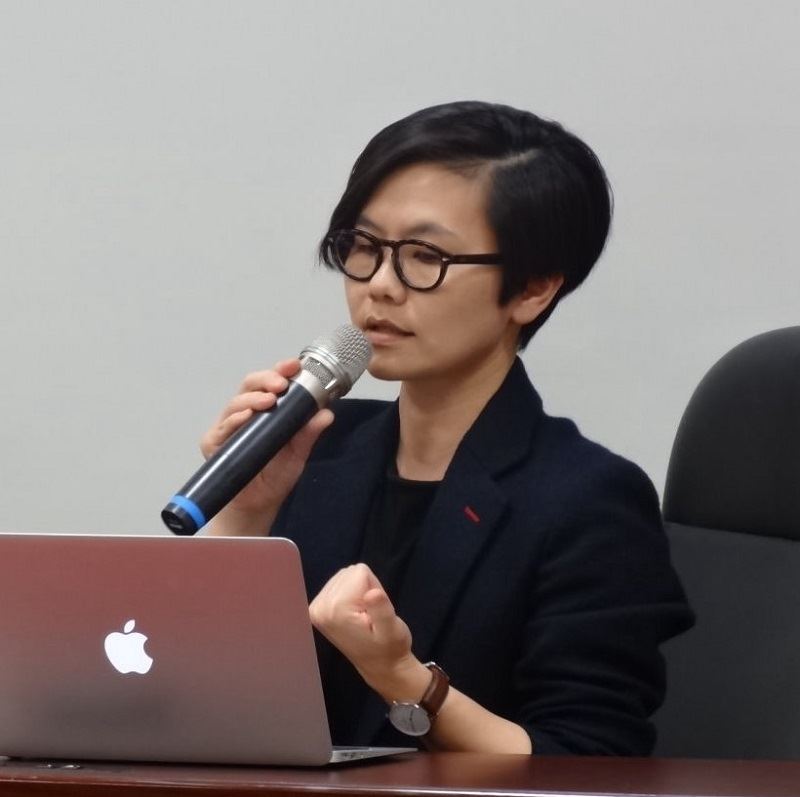
▲Professor Eno Pei-Jean Chen 陳佩甄/ Photo credit: Pei-Jean Chen
For graduate school, she attended National Chiao Tung University 國立交通大學, in their social research and cultural studies program. Through her master’s thesis and independent research, she was able to establish herself as a researcher and academic. This led her to begin to consider becoming a professor, a position she was drawn to due to the independent nature of the work. Around that time, she also got in touch with Chi Ta-wei 紀大偉, at that time an already well-established name in the world of Taiwan Queer theory and Queer translation discourse, who was studying at the University of California, Los Angeles (UCLA). He was one of the main contributors who created the term 酷兒 and helped professor Chen to plan for her PhD in the US. He now also works in the Taiwanese Literature Department at NCCU.
While working on her master’s thesis, Chen visited South Korea for the first time in 2005. There, she presented on Queer translation in Mandarin and met many peer Korean scholars. As she learned more and became more embedded in these circles, she became more and more curious about how Queer theory is translated into the Korean language. In fact, she explained that Korea had the first pride parade in Asia, in 2000, one year before Taiwan’s. That year, there were only about 50 participants, who specifically chose to label themselves as a transliterated version of “Queer,” 퀴어, rather than “same sex love,” in an effort to not be associated with the already stigmatized label, such that they would be allowed to hold a parade. Basically, Queer Korean activists were able to repackage the pride parade as a “cultural festival” rather than something viewed as “unnatural” and associated with Western culture. After 2008, she went back to Korea frequently and continued to develop South Korea as a research interest especially as it relates to Queer theory.
After receiving her master’s degree in 2006, Professor Chen worked in a commercial publisher, at China Times Publisher. This was followed by some time at an indie magazine, 破週報 (pò zhōubào), which reported on social movements, particularly those relevant to gender and LGBTQ discourses.
Finally, Professor Chen went on to receive her PhD in Asian Studies from Cornell University, located in Ithaca, New York, USA, in 2016. While completing her PhD, she saw that South Korea and Taiwan were both somewhat peripheral areas of study within the umbrella of “Asian Studies.” Simultaneously, she found that it was very important to her to unpack the epistemology of sexuality and gender studies, since so much has happened in the field just since the 20th century. These concerns led her to her current research.
Research Interests
Professor Chen spoke about the production of identifiers for people that in English would be called things like “LGBT,” “Queer,” “gay,” etc. She stated that the 1990’s was the beginning of the “Queer” translation discourse. The first round of translation discourse focused on translating the meaning alone, and left Mandarin-speakers with words like 變態 (biàntài, lit. “abnormal, perverted). Then, field pioneers like 紀大偉 among others transliterated “Queer” into “酷兒” (kù’ér). While this word has remained comparatively more in favor, many older Taiwanese Queer people might prefer something more like “同志” (tóngzhì, lit. “comrade/gay”). Chen’s work essentially analyzes how these discourses are produced, and treats these identifiers and the cultures surrounding them as “cultural politics” rather than identity politics.
Some of Chen’s recent work focuses on archiving pieces of Taiwanese Queer culture. She spoke about an exhibit she and other Queer archivists and researchers put together which was shown earlier this year. Specifically, Professor Chen talked about a lesbian club at NCCU in the 1990’s, Kiwa, 奇娃社. At that time, such a group was somewhat underground and had to use more creative methods to get the word out about their club. Professor Chen recalled a sticky note which Professor Chi 紀大偉 had found, which was advertising the club, but unfortunately Professor Chi had forgotten where he found the note. In order to follow the thread, Professor Chen went to the library and thought to look in popular Queer literature books, checking 陳雪’s book, 陳春天, where she found a similar note letting students know to look for Kiwa on the bulletin board system (BBS) in the early 2000’s. Kiwa was not only an important identity-based club at NCCU, but it was also important to greater Taiwanese discourses about Queerness and Queer liberation. This sticky note and other important cultural artifacts were shown at the exhibit, “(de)phallocentrism,” “背陽—情慾伏流及其隱現.”
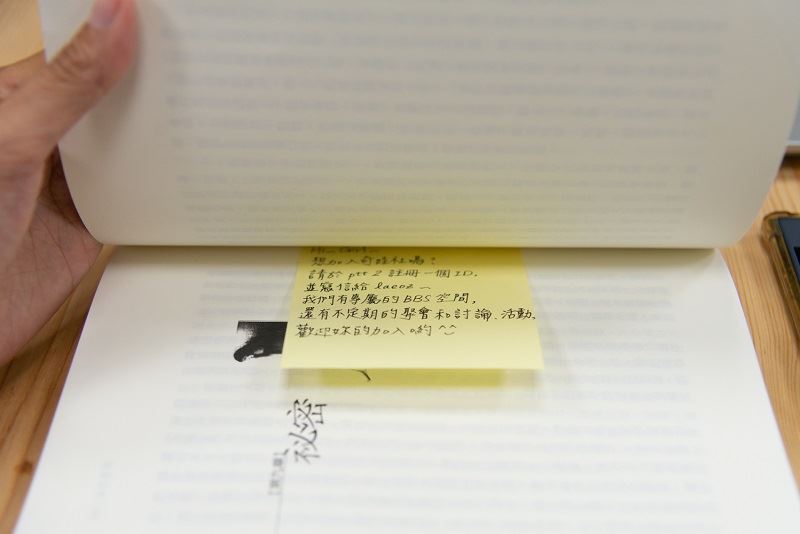
▲Sticky note from Kiwa (政大奇娃社)/ Photo credit: Pei-Jean Chen
Looking forward, Professor Chen is working on two books. First, Cultural Politics of Love : Colonial Genealogy of Modern Intimate Relationships in Taiwan and Korea, offers a new cultural history of colonial world order through inter-referencing Taiwanese and Korean construction of modern love and sexuality, and their historical responses to Western and Japanese imperialism. The subsequent project Cold War Feelings focuses on the legacies of colonialism and the cold war ideology of gender normalization, sexuality and affect in postwar Taiwan and South Korea.
Professor Chen emphasized that the idea of “love” is a contested one; Queer people and allies can often be heard proclaiming “love is love,” ie Queer love and straight love are both love and that is of the utmost importance. Actually, many Queer activists argue that this way of thinking is assimilationist and reductive. And using this idea of love can actually be weaponized against Queer people by the far right; “same-sex love is not love.” This idea of love is so important because love is seen as the way to “enlighten” the People. Correlatively, to maintain the idea of free love, it is seen as important to forbid the carnal sexual desire seen as associated with Queer love. In reality, without same-sex love, there is no idea of what romantic love is.
Chen stated that some may view the Queer liberation movement and human rights movements generally in Taiwan as pandering to the US and Western values. In some ways, in fact, it is. For the Taiwanese government and Democratic Progressive Party (DPP), aligning themselves with Western human rights movements is a sort of insurance policy, in order to differentiate themselves from China and in the hopes that Western powers will view Taiwan as a democratic Asian nation with a clean human rights record. In this way, love is conceptualized as key to “civilizing the nation.” Professor Chen’s work is key to the Taiwanese Queer literary canon and holds a nuanced position in the conceptions of colonialism, love, and Queerness.
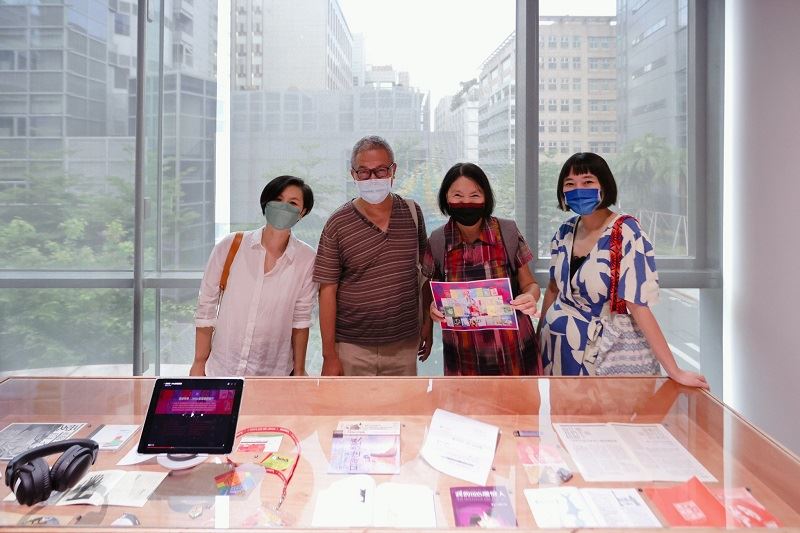
▲With important Queer activists-Kefei (喀飛) and Meili Cheng (鄭美里)
/ Photo credit: Pei-Jean Chen